


Regulatory Context For Ventilation Ductwork
Ventilation ductwork plays a critical role in maintaining building safety, indoor air quality, and energy performance. Its design, installation, and long-term performance are governed not only by technical standards but also by an evolving set of regulations. Understanding this regulatory context is essential for consultants, designers, and contractors responsible for building services systems.
 The Building Safety Act 2022 introduced a new legal framework for higher-risk buildings in England. It places stronger duties on clients, designers, and contractors to deliver safe buildings and to demonstrate competence and compliance. Although not ductwork-specific, it reinforces the need to follow recognised industry standards such as DW/144 when designing and installing ventilation systems.
The Act also introduced the concept of a Golden Thread of information, requiring duty holders to create and maintain accurate, accessible records throughout a building's lifecycle. For ventilation systems, this includes technical documentation for ductwork specification, pressure class, air leakage limits, and installation methods. DW/144 provides the structure necessary to support this requirement, ensuring a consistent approach from design through to fabrication, installation, and inspection.
Alongside the Building Safety Act, ductwork must also comply with key areas of the Building Regulations, including:
- Part F (Ventilation), which sets minimum standards for indoor air quality and airflow rates
- Part L (Conservation of Fuel and Power), which requires systems to be energy efficient, including limits on air leakage and fan energy use
Other relevant standards, such as BS EN 12599, outline procedures for testing and commissioning ducted air distribution systems. These documents help verify that installed systems meet the design intent and comply with national requirements.
DW/144 supports compliance with all relevant frameworks by defining how contractors must construct, seal, test and classify ductwork to meet safety and energy regulations. As buildings become increasingly complex and regulatory oversight intensifies, ductwork must not only deliver the intended performance but also demonstrate that it meets verifiable standards. DW/144 provides the foundation for both performance and accountability.
DW/144 And Other Relevant Standards
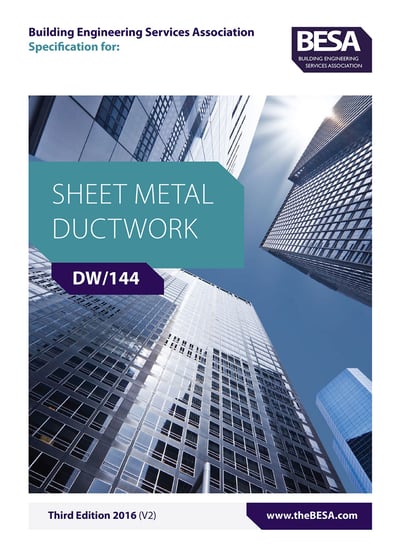
DW/144 is the recognised UK specification for sheet metal ductwork used in air distribution systems. Published by the Building Engineering Services Association, it provides the technical foundation for the design, manufacture, and installation of both rectangular and circular ducts. For a deeper look at how sheet metal ductwork standards have evolved and why they matter, read our article on sheet metal ductwork standards. It is the most widely adopted standard across commercial and public sector buildings in the UK and is often referenced directly in specifications, contracts, and compliance documentation.
The purpose of DW/144 is to ensure that ductwork systems meet minimum requirements for strength, air leakage, construction quality, and performance under pressure. It covers material thickness, jointing methods, sealing classifications, reinforcement spacing, allowable deflection, and support arrangements. The standard also includes diagrams and tables that help translate design intent into practical construction detail.
Although the law does not mandate DW/144, professionals across the industry widely use it to demonstrate compliance with statutory regulations. It supports key areas of the Building Regulations, particularly:
- Part F, which relates to ventilation and indoor air quality
- Part L, which addresses the conservation of fuel and power
- General safety provisions under the Building Safety Act 2022, especially for higher-risk buildings
In addition to DW/144, several British and European standards provide further guidance on the performance and testing of ventilation ductwork. These include:
- BS EN 1507: Specifies requirements for the strength and leakage of rectangular ductwork
- BS EN 12237: Covers circular ductwork made of sheet metal and its leakage performance
- BS EN 12599: Details methods for measuring, commissioning, and verifying the performance of installed ventilation systems
- BS EN 14239: Relates to insulation requirements for duct systems to limit heat gain or loss
These standards complement DW/144 by setting additional performance criteria, particularly in energy efficiency, airtightness and commissioning. On most projects, DW/144 forms the foundation for specification, while EN standards help confirm that the installed system performs as expected during testing and handover.
By aligning specifications with DW/144 and the relevant British and European standards, consultants and contractors ensure that ductwork systems meet both regulatory and performance benchmarks. Adopting this approach also gives clients confidence that the system has been delivered according to recognised industry best practice.
Common Pitfalls In Non-Compliant Installations
Non-compliant ventilation ductwork can undermine building safety, reduce system performance and create long-term maintenance challenges. Whether caused by oversight, poor specification or limited awareness, any deviation from standards like DW/144 often introduces problems that are costly and time-consuming to resolve.
Incorrect pressure class selection ranks among the most frequent issues. When ductwork lacks the required strength for the specified pressure, structural failures can occur. Ducts may collapse or develop joint leaks, which restrict airflow, increase energy consumption and compromise indoor air quality. These risks are particularly pronounced in rectangular ductwork, which has unique structural and leakage characteristics compared to circular systems. If you're unsure how rectangular ducting should be designed or reinforced, our article on rectangular ductwork explains key considerations and common configurations.
Another common problem is poor sealing and joint construction. Incomplete or incorrect sealing can lead to excessive air leakage, which directly impacts system efficiency and can prevent compliance with Part L of the Building Regulations. It may also result in pressure imbalances across the system, increasing fan loads and causing discomfort for occupants.
Improper support and reinforcement are also frequent causes of non-compliance. If ducts are not reinforced or supported at the intervals specified in DW/144, they may sag, twist, or deflect beyond acceptable limits. Poorly routed ductwork often interferes with other services, restricts access or damages fittings and dampers. Another common risk is the failure to coordinate with other building systems. When teams install ductwork without accounting for ceiling voids, fire-stopping zones or structural elements, they often face last-minute design changes or resort to unsafe modifications. DW/144 provides clear guidance on tolerances and access requirements to prevent such clashes.
Inadequate documentation also leads to non-compliance. The Building Safety Act requires duty holders to record how they design, install and test ventilation systems. Without well-documented specifications, test results and drawings, project teams struggle to prove that the system meets the required standards.
Project teams can avoid most of these pitfalls by applying DW/144 correctly from the start and assigning installation to competent personnel. The specification provides clear structure and guidance that helps project teams deliver safe, efficient and compliant ductwork systems with long-term reliability.
How To Use DW/144 To Stay Ahead Of Compliance
DW/144 is more than a fabrication standard. It is a comprehensive specification that supports compliance across the full lifecycle of a ductwork system. When applied correctly, it helps consultants, contractors, and clients meet regulatory requirements, avoid performance failures, and maintain accurate records that support long-term building safety.
The most effective way to use DW/144 is to integrate it early in the design process. The process begins with applying the correct pressure classifications, air leakage limits and material thicknesses defined within the document. By aligning with these technical requirements from the outset, designers can minimise ambiguity in specification documents and ensure a consistent standard throughout the supply chain.
At the tender stage, DW/144 outlines measurable criteria that evaluators can apply when reviewing proposals. Procurement teams gain confidence that bidders have grounded their submissions in recognised quality standards rather than relying on value-engineered assumptions that could result in non-compliant outcomes.
During construction, DW/144 becomes a vital reference for fabrication, installation, and inspection. It sets clear expectations for joining methods, sealing classes, reinforcement spacing, and support intervals. Site teams can use the specification to check that ductwork has been delivered and installed in accordance with approved drawings and best practice.
The Building Safety Act and Golden Thread requirements place a legal duty on responsible parties to maintain accurate records throughout the building lifecycle. DW/144 supports this obligation by providing a consistent framework for documenting duct sizes, materials, pressure ratings and performance criteria. That record-keeping ensures that future testing and maintenance teams can work with a complete understanding of the original design.
Finally, DW/144 supports continuous improvement. By using the specification as a benchmark, companies can train their teams, refine installation practices, and improve quality assurance processes. Following a transparent and standardised specification reduces the likelihood of defects, improves system reliability and enhances client confidence.
In a regulatory environment that continues to tighten, relying on DW/144 is not just a matter of technical accuracy. It is a proactive approach to managing compliance risk, enhancing system outcomes, and upholding professional standards across the building services sector.
Supporting Quality Across The Ductwork Lifecycle
Achieving consistent, long-term performance from a ventilation system requires more than correct installation. Successful system performance relies on embedding quality at every stage of the ductwork lifecycle, from design through to maintenance. DW/144 provides the structured guidance needed to support this approach and ensure that systems remain safe, efficient, and compliant over time.
At the design stage, DW/144 enables consultants to specify duct sizes, pressure classes, air leakage limits, and construction methods that are appropriate for the building type and usage. It provides the technical clarity needed to avoid ambiguity and sets a benchmark for system performance. Aligning with DW/144 early in the process helps project teams deliver the design accurately on site.
During fabrication and installation, the specification defines construction standards including material thickness, jointing methods, reinforcement spacing, and support arrangements. Consistent use of DW/144 throughout the supply chain ensures uniform artistry and minimises the risk of on-site deviations that could impact performance or compliance. To help project teams get the specification right from the outset, our ductwork specification guide offers a concise overview of the technical inputs and site realities that must align during planning and execution.
During the commissioning and inspection phase, DW/144 provides reference points for verifying whether the installation aligns with the design specification. The specification covers key factors, including tolerances, sealing levels, and construction quality. In line with the Building Safety Act and the Golden Thread requirements, these checks contribute to a documented record that confirms the integrity of the system.
In the operation and maintenance phase, ductwork systems built to DW/144 are easier to inspect, service, and maintain. Their consistent construction and known pressure classification make it easier for facilities teams to access components, assess condition, and plan remedial works. Aligning with the specification supports whole-life system efficiency and helps building operators meet their ongoing regulatory obligations.
By using DW/144 as the reference point across all stages, project teams can reduce risk, improve quality assurance, and deliver ventilation systems that perform as intended throughout their lifecycle. It is not only a technical document. It is a tool for delivering confidence, consistency, and compliance throughout the entire process.
Key Takeaways
- DW/144 supports compliance with the Building Safety Act and Building Regulations.
- It provides technical clarity across design, installation, and maintenance.
- Using DW/144 ensures performance, consistency, and regulatory confidence.
- Project teams must maintain quality across every stage of the ductwork lifecycle.
- Accurate documentation and inspection are critical under the Golden Thread.
Explore More On Ductwork Standards
Essential Guide To Sheet Metal Ductwork
Download the full DW/144 Specification Guide from the BESA Publications website.