



AI can have a positive impact on building engineering businesses, but managers need to set clear rules for its use and maintain firm ‘guardrails’ to reduce risks, according to the executive editor of The Economist Andrew Palmer.
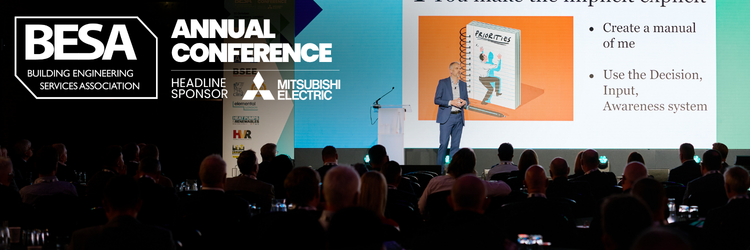
Speaking during his keynote address to last week’s BESA Annual Conference, Palmer described AI as having reached “a weird moment” where it is creating jobs (not replacing them) but not making money or delivering much in the way of productivity improvements. However, that will change.
“AI is not at job level yet…it is still largely restricted to narrow tasks without too many variables,” Palmer told his audience at The Brewery, London where more than 300 delegates representing almost 150 companies came together for a packed one-day programme, which was sponsored by Mitsubishi Electric.
“AI is not impacting employment levels yet so it will take a long time to reach the [predicted] ‘jobs apocalypse’,” said Palmer, who hosts the podcast Boss Class.
However, he warned managers to set clear parameters for how AI is used in their businesses now and not simply “hand over the keys to the castle”. He said critical thinking, creativity and understanding emotion was now “all the more important” and advised against “cognitive surrender” where people meekly hand over important decisions to AI despite being afraid of the potential outcomes.
Business growth
BESA President Anna Shephard opened the Conference by highlighting the importance of companies aspiring to higher professional standards to support their business growth.
“Over the last few years, we have seen a much greater focus on legal and technical compliance. Some businesses saw this as additional red tape and yet another layer of complexity on already demanding projects,” said Shephard.
“BESA members and their supply chains are, however, increasingly recognising that higher standards are not simply something we have to comply with. They can give our businesses a genuine advantage.”
She also highlighted the fact that the BESA Conference had attracted a higher number of young engineers than ever many of whom took part in live demonstrations in the WorldSkills UK theatre which was an innovation for the 2026 event.
CEO David Frise said the Association’s Member Pledge initiative had given companies a way to manage the “things they can control by supporting their supply chains rather than waiting for someone else to do something”.
Five more firms signed up to the Pledge during the Conference: Skanska, Mellor Bromley, Dalkia Facilities, Price Building Services and Bancroft.
BESA’s Competence Assessment Standard (CAS) audit undertaken by all member firms sets a high benchmark for professional competence and compliance, which has clear business benefits, he said.
“This is a complex industry and we are unapologetically technical…and having CAS allows you to show that you meet the standard. [You can say] we will no longer come down to your standard you have to come up to ours.”
He also hailed the progress being made to eradicate unfair payment practices and abolish retentions following “years of work” by BESA members and staff.
The overall theme for the day was: Beyond Compliance – Raising Standards, Proving Competence & Delivering Better Buildings. Across five theatres, delegates heard from industry leaders and technical experts on business growth, building safety, competence and skills.
The Building Safety Act was once again a key topic for debate, and the second keynote address was delivered by Dr Barbara Lane, a leading fire safety engineer and the first independent chair of the Building Advisory Committee which is part of the Building Safety Regulator.
She told the Conference that tens of thousands of people were still living in unsafe homes almost a decade after the Grenfell Tower tragedy. The Regulator is overseeing 4,724 buildings over 11 metres in height and as many as 81% are expected to need remedial work to make them safe.
‘It wasn’t just the cladding’
Dr Lane said the industry had a long way to go to regain public trust and reminded delegates that “it wasn’t just the cladding” that made Grenfell Tower and hundreds of other buildings unsafe. She highlighted that the smoke ventilation system had fallen into disrepair and the dampers were “uncertified” so may have allowed more smoke into the lobby areas at Grenfell.
“They were specified with scant regard for fire safety,” she said and this subject was taken up later during a Conference session covering ‘The Great Damper Dilemma’. There the panel updated delegates on a case study and technical guidance for better reporting of safety issues discovered during building maintenance which is due to be published by BESA next month.
This is regarded as an important test case that the Regulator may be able to apply to other areas of the construction sector and help drive the new safety culture through supply chains.
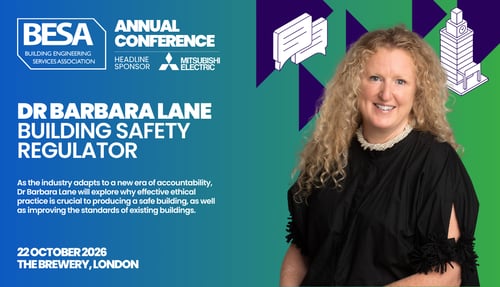
Dr Lane also urged the Regulator to clear up an ongoing misconception that the Act only applies to higher risk buildings (HRBs) and stress that all building stakeholders must have a safety risk action plan*.
The Conference also heard that while awareness of the Act had risen to new heights there were still widespread problems with providing evidence of competence and compliance. Also, many clients had still not changed their approach to specification, according to BESA’s recently published annual survey.
“Four years after the Act came into force, more firms are building the knowledge and behaviours needed for a safer built environment,” said BESA’s director of specialist knowledge Rachel Davidson. “This represents real progress and we are now moving from raising awareness to helping firms meet the assurance challenge i.e. demonstrating their competence and compliance in practice.”
She noted that one in three respondents to the BESA research reported major challenges with demonstrating competence in practice, stressing the very real difference between holding a qualification and "actually being able to do the work".
“We are seeing warranties now being included in contracts that require contractors to show that people are competent and remain competent throughout a project,” BESA’s senior legal & commercial adviser Tyler Felix told the Conference.
“Qualifications alone are not enough and if there is no evidence of ongoing competence there are penalties. This is not about the Regulator overseeing in an abstract way…there are real, financial penalties.”
Jon Vanstone, chair of the Industry Competence Committee, added: “The industry is very good at fixing problems when they occur but doesn’t have a system that will stop the same errors happening again. This often comes back to the client who sets the tone and can put the compliant culture in place.”
Potential demand
The link between higher professional standards and overall business success was a theme that ran throughout the sessions held across the BESA Conference’s five breakout rooms. Several discussion panels highlighted huge potential demand for building engineering services in many key markets.
Growth in digital infrastructure, healthcare, the NHS and defence was high on the agenda, but several speakers lamented the difficulty of unlocking investment to allow the sector to fulfil its full potential.
Shortly before the Conference, BESA delivered a five-point Manifesto Building Britain’s Future to 10 Downing Street. This set out the argument for greater investment in building engineering services that could help the government deliver its plans to increase housing supply, improve public services and meet net zero targets.
*Dr Lane's keynote was recorded for broadcast as a BESA Podcast and will be available to view from 29 October.
BESA’s Building Safety Act survey can also be downloaded for free here. The Association presented a cheque for £1,000 to the Lighthouse construction charity at the Conference - the money was raised by its campaign to encourage more survey responses.