



A new guide outlining their roles and responsibilities under the Building Safety Act has prompted some questions about how seriously clients are taking the new safety regime, writes BESA's director of specialist knowledge Rachel Davidson.
 The Client’s Guide to the Building Safety Act published by the Building Engineering Services Association (BESA) was produced in response to BESA research, published late last year, that revealed many clients still procure projects primarily on cost and speed of delivery despite dire warning about how this contributes to quality and safety problems.
While clients ultimately bear most of the legal risk if their building contributes to death, injury or wider health and wellbeing issues, many seem to think they can pass that risk on to others through the procurement process.
BESA’s Clients’ Guide to the Building Safety Act points out the many weaknesses in this approach and seeks to explain how a client can comply with the legislation; not just to protect themselves from liability but also to enjoy a higher quality project and all the benefits that a better building brings to them and their own clients – the building’s users.
This new guidance, produced in collaboration with eight other industry bodies*, sets out clients’ legal duties and emphasises their leadership role in the industry transformation needed to keep all building occupants safe and protect their long-term health and well-being. It reiterates the message that the new building safety regime applies to ALL buildings, not just higher risk (HRB) or high-rise residential developments.
Boiling Down Complexity
The new guide also boils down the complexity of the legislation into simplified guidance using plain English and avoiding the overload of information that can lead to important messages being misunderstood or ignored.
Jon Vanstone, chair of the Industry Competence Committee (ICC), which advises the Building Safety Regulator, said BESA’s guide was a timely reminder of the central role clients play in delivering compliant and safe buildings.
“The Building Safety Act places clear legal duties on clients. They set the tone for projects through their procurement decisions, appointments and allocation of resources".
“If those duties are taken seriously and supported by competent appointments and informed oversight, the quality and safety of outcomes will improve. If they are not, no amount of downstream control can fully compensate,” said Vanstone.
“Guidance that helps clients understand both their statutory responsibilities and the practical implications of those responsibilities is therefore welcome, particularly where it aligns with the Regulator’s Principles for Informed Clients and supports consistent cross-industry understanding.”
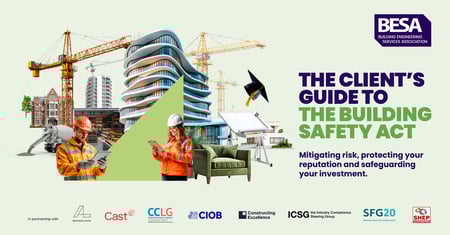 The BESA Clients’ Guide defines ‘Who is the Client’ and the legal requirements of that role. It sets out the client’s duties and how they can ensure their project remains compliant at every stage and the potential consequences of failure. It also explains the specific rules and processes required for HRBs, how to avoid common problems and further resources available.
Lilly Gallafent, CEO of the Real Estate consultancy Cast, said the BESA guide was a timely reminder to clients of the need to take a long-term view.
"Change needs to start with clients,” she said. “Whilst many already do, clients all need to recognise that they have the power to drive a new culture through their supply chains, but they need to be willing to allocate risk fairly and focus on how their decisions will affect the operational life of their buildings."
"Pushing hard for cost savings at the start of a project can, when not managed appropriately, end up being very expensive in the long run and risk needs to be properly assessed and not just pushed down the supply chain," said Gallafent.
"This excellent guide reminds us that this is a once in a generation opportunity to bring about meaningful and lasting change to construction procurement for the benefit of the industry and all building users."
Deeper question
Yet, there is a deeper question here: Do clients actually consider themselves to be part of the industry at all? Or, do they think that, as customers of the industry they are not subject to its rules and constraints – that it is for the professionals they appoint and pay to sort out any risk issues on their behalf?
This goes right to the heart of industry reform. There are literally dozens of committees and sub-committees working on competence definitions and requirements on behalf of the construction industry and its many related technical professions. While this work is long overdue, it is now nailing down the specifics of what ‘good looks like’ when it comes to some of the detailed aspects of a project, but who is working on the same for clients?
The industry’s new favourite acronym is SKEB – Skills, Knowledge, Experience, and Behaviours – and while you could argue there has been good progress on the first three; the thorny issue of behaviour (which you could also describe simply as ‘acting with integrity’ or doing the right thing) remains a difficult, grey area that is extremely difficult to measure.
However, many clients are doing the right thing and showing an example by facing up to their responsibilities and embracing their role as active members of the industry supply chain. This is most definitely in their best interests because informed and engaged clients are best placed to ensure projects are delivered safely, compliantly and in line with regulatory requirements, protecting both long-term building performance and investment value.
The new BESA Guide provides a blueprint for how the informed client can step up and lead the industry into safer, healthier and better performing buildings.
*The BESA Clients’ Guide to the Building Safety Act is also supported by Constructing Excellence, the Chartered Institute of Building (CIOB), the Construction Clients’ Leadership Group (CCLG), Cast Consultancy, SFG20, The Industry Competence Steering Group, Ackroyd Lowrie and the Safety & Health Engineering Partnership (SHEP).
The guide, which can be downloaded for free here, will also be the focus of a special building safety briefing event at the Palace of Westminster on May 5.
For more information about complying with the Building Safety Act visit the BESA Hub.