



The Building Engineering Services Association (BESA) has updated and improved its best practice guidance for local exhaust ventilation (LEV) to help reduce the risk of thousands of workers developing serious and life-limiting health conditions, including occupational asthma and pulmonary disease.
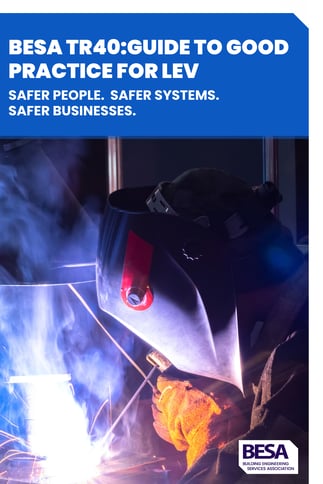 TR40: ‘A Guide to Good Practice for Local Exhaust Ventilation’ was jointly produced by the Association and the Institute of Local Exhaust Ventilation Engineers (ILEVE) in 2020. It has now been updated to reflect industry best practice and increased knowledge of the risks posed to workers by exposure to harmful airborne contaminants in the workplace.
The revised guide reflects the RIBA Plan of Work, covering the requirements of an LEV project from conception through to design, planning and installation, as well as ongoing operation and maintenance. This includes details of the tasks, responsibilities and decision-making processes involved.
The update uses RIBA Plan of Work stages 0 to 7 to map the life cycle of an LEV project, from strategic definition through design, construction, handover and use. It also adds an additional stage providing guidance on dismantling and disposing of systems at the end of their operational life.
Principles
BESA is also offering an online awareness course that provides an overview of TR40 and helps learners understand its key principles and requirements.
Details of the inspection and testing measures required during the operation of an LEV system have also been enhanced. The guide emphasises the importance of appointing suitably competent and qualified individuals to carry out every aspect of LEV work.
The guide is aimed at the entire LEV supply chain, including owners and operators, designers, suppliers, project managers, commissioning engineers and technical trainers. Updated examples of the supporting documents required for use with LEV systems are included in the appendices.
“This Guide to Good Practice plays a vital role in promoting competence and professionalism across the LEV sector to protect people from exposure to hazardous substances in a wide range of workplaces,” said BESA’s head of health and safety, Rebecca Crosland.
“Instances of occupational lung disease, including cancer caused by dust, fumes and other airborne contaminants in the workplace, remain unacceptably high.”
“Compliance with TR40 could help the construction industry prevent thousands of workers every year from developing occupational asthma, chronic obstructive pulmonary disease (COPD) and other life-limiting respiratory conditions,” she added.
TR40 can also play an important role in helping employers meet their statutory obligations under the Health and Safety at Work etc. Act 1974 and the Control of Substances Hazardous to Health (COSHH) Regulations.
It should also be used in conjunction with the HSE guidance HSG258: Controlling Airborne Contaminants at Work. This reminds employers that they have a legal responsibility to ensure employee exposure to dust, fumes and other airborne contaminants is minimised and effectively controlled.
The HSE also calls for the periodic examination and testing of LEV systems at least once every 14 months, with inspection records retained for at least five years.
“In addition, you should have information on the installed LEV system to confirm it provides adequate protection, which should be kept for the life of the equipment,” its guidance says.
The updated BESA guidance and awareness course reflect the many niche specialisms within LEV. TR40 provides detailed guidance on all elements and types of the technology.
Sectors including woodworking, foundries, stonemasonry, welding and other construction activities are regarded as high risk. The HSE has encouraged the production of focused, industry-led guidance such as TR40 to help responsible employers manage risks in these environments.
Modified Systems
The guide points out that installed systems are often modified and operating conditions can change as a workplace evolves. Employers should therefore ensure that LEV systems are regularly inspected and continue to be fit for purpose.
TR40 explains how to manage this process and outlines common problems engineers may encounter. For example, it explains how airflow indicators can be used to demonstrate whether the performance of an LEV system has deteriorated and requires remedial work.
“TR40 will help clients and project managers ensure the LEV requirements of new construction projects are efficient and cost-effective by involving appropriate specialists from design through to handover,” said BESA technical director Kevin Morrissey.
“This will help avoid the use of ‘off-the-shelf’ solutions, which can be costly and ineffective and put the client at risk of breaching their statutory obligations.”
“FM companies are often unaware of their own legal obligation to ensure that an LEV system effectively controls hazardous substances, and the test reports they submit to clients can fail to include this crucial information,” he added.
“By requiring their contractors to comply with TR40, FM organisations can ensure they are provided with a fully compliant service. A competent LEV engineer will be able to recommend low-cost modifications that enable the LEV system to meet statutory requirements.”
BESA’s TR40 ‘Guide to Good Practice for Local Exhaust Ventilation’ can be accessed through the BESA publications website.